PTWA Summary of Judgment
“Women are either for the home or the grave.” As an Afghan woman testified before the People’s Tribunal for Women of Afghanistan (PTWA), its panel of eight judges[1] presided by Rashida Manjoo, and the many observers in attendance somberly listened. Another survivor stated: “These are not just my words; this is the pain of women who have been silent for the past four years and could not speak out. They were alive but not living; they were just breathing.”
These were some of the stories shared during the PTWA’s two-day hearings, followed by a preliminary statement of the judges on the third day, which took place in Madrid, Spain, from 8 to 10 October 2025. One after another, 24 survivors and witnesses described the harrowing situation of approximately 21 million women and girls living under the Taliban regime. The PTWA, which stemmed from a December 2024 request to the Permanent Peoples’ Tribunal (PPT) by four human rights organizations (the Requesting Organizations), was constituted after the PPT determined that the situation of women and girls in Afghanistan was a matter of urgent competence for the Tribunal.[2] Thereafter, a group of four prosecutors appointed by the Requesting Organizations submitted an Indictment against ten senior Taliban leaders and the Taliban as an organized group for violations of International Criminal Law, as well as against the State of Afghanistan for violations of International Human Rights Law. All accused were notified and invited to exercise their right of defense, but no response or participation was received.
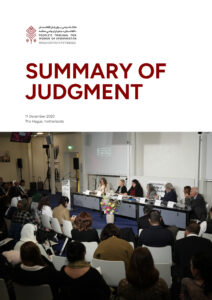
After reviewing the Indictment and its supporting evidence, as well as holding the three-day hearing in Madrid, the Tribunal issued its Judgement on 11 December 2025 in the Hague. Based on extensive witness testimony and documentary evidence, the Tribunal found (among other things) that the Taliban has, since August 2021:
- Arbitrarily detained, tortured, and perpetrated ill-treatment against women;
- Forcibly disappeared women activists and protesters;
- Systematically excluded women and girls from education beyond the primary level;
- Widely banned women’s employment and public participation;
- Severely restricted women’s freedom of movement, expression, assembly, and bodily autonomy;
- Consistently denied healthcare to women and girls, including by imposing gender-based barriers to medical treatment; and
- Eliminated any access to justice and legal remedies for women.
As a result, the Tribunal concluded that the Taliban’s policies and actions constitute crimes against humanity, particularly the crime of gender persecution as defined under Article 7 of the International Criminal Court’s (ICC) Rome Statute:“The Taliban’s sustained and deliberate campaign of gender-based persecution, carried out through edicts, institutional decrees, and systemic violence, constitutes a direct and egregious violation of international criminal law [and] [t]he Taliban, as the de facto governing authority, bears responsibility under criminal law for a policy of gender-based persecution constituting crimes against humanity.” Additionally, the Tribunal held that the Taliban have committed other inhumane acts causing great suffering or serious injury to the mental and physical health of women and girls.[3]
Accordingly, the Tribunal determined that the 10 accused senior Taliban leaders bear individual criminal responsibility for designing and enforcing discriminatory policies. Moreover, the Tribunal agreed that collective and structural responsibility should also attach to institutions, ministries, security forces, courts, and religious bodies for implementing and sustaining the system of gender persecution.
As to the State’s responsibility for violating International Human Rights Law, the Tribunal found that Afghanistan, under de facto control by the Taliban, has deprived women and girls of their fundamental rights (with exacerbated, intersectional impacts on the rights of individuals with disabilities), including:
- The right to life;
- The right not to be subjected to torture or to cruel, inhuman or degrading treatment or punishment;
- The right to personal liberty and security;
- The right not to be subjected to arbitrary detention;
- The right to education;
- The right to work;
- The right to health;
- The right to freedom of expression;
- The right to freedom of movement;
- The right to freedom of assembly and association;
- The right to bodily autonomy; and
- The right to civil and political rights of participation.
In so finding, the Tribunal highlighted that “the severe deprivation of women’s and girl[s]’ fundamental human rights will have an intergenerational impact, directly affect Afghan society, but also have implications globally for other societies where the violation of the rights of women and girls is normali[z]ed – with impunity as the norm.”
As the above-enumerated fundamental rights are protected by various binding international human rights treaties to which Afghanistan is a State Party, their contravention constitutes violations of the State’s international obligations under: (1) the Convention on the Elimination of All Forms of Discrimination Against Women (CEDAW); (2) the International Covenant on Civil and Political Rights (ICCPR); (3) the International Covenant on Economic, Social, and Cultural rights (ICESCR); (4) the Convention Against Discrimination in Education (CADE); (5) the Convention on the Political Rights of Women (CPRW); (6) the Convention on the Rights of the Child (CRC); (7) the Convention Against Torture and Other Cruel, Inhumane, Degrading Treatment or Punishment (CAT); and (8) the Convention on the Rights of Persons with Disabilities (CRPD).
The Tribunal rejected any potential claims that the above violations are mandated by Islamic law. Based on expert testimony, the Panel of Judges found that the Taliban’s interpretation of Sharīʿa is selective, politicized, and inconsistent with established Islamic jurisprudence and scholarly consensus, particularly regarding women’s rights to education, work, healthcare, and public participation.
Given the many violations of both International Criminal law by both individual Taliban leaders and collectively by the Taliban as a group, as well as breaches of International Human Rights law by the State of Afghanistan, the PTWA called for, among other things:
- The Taliban’s immediate repeal of discriminatory decrees and restoration of women’s fundamental rights in Afghanistan;
- International recognition of the Taliban’s conduct as gender persecution and crimes against humanity;
- The continued non-recognition of the Taliban authorities unless there is measurable compliance with women’s rights obligations;
- The Organization of Islamic Cooperation, Islamic countries, and Islamic institutions and scholars to collectively take a firm and principled stance against the Taliban’s restrictions on women as contrary to Sharīʿa;
- The United Nations (UN) to ensure that the recently established independent investigative mechanism for Afghanistan is swiftly operational;
- The UN and Member States to support the codification of gender apartheid as a crime against humanity under international law;
- The ICC to expedite investigations into crimes against humanity on gender grounds and its State Parties to fully cooperate in executing arrest warrants;
- Australia, Canada, Germany, and the Netherlands take timely and transparent steps to advance CEDAW proceedings before the International Court of Justice;
- The activation of additional international accountability mechanisms, including universal jurisdiction;
- The inclusion and meaningful participation of Afghan women as key actors and contributors to all accountability processes;
- The international community to continue providing humanitarian and development support directly to the Afghan people without engaging the Taliban administration; and
- Protection and support for Afghan human rights defenders.
Overall, the PTWA represented a venue for truth-telling, recognition and public judgment that plays a part in restoring voices where silence had been imposed. In doing so, it has helped honor the unwavering courage of the women of Afghanistan and their relentless pursuit for justice, dignity, and equal rights.
The requesting Organizations are hopeful that the PTWA’s judgment will hereafter help raise awareness, demand solidarity, and remind the international community that a different future is possible not just for the the women and girls of Afghanistan, but for all women around the world, as long as the “crime of silence” is broken before it is forever entrenched as complicity.
[1] The panel of judges included nationals from Afghanistan, Egypt, India, Italy, South Africa, Spain, and the United States.
[2] The Requesting Organizations were: (1) Rawadari; (2) the Afghanistan Human Rights and Democracy Organization (AHRDO); (3) the Organization for Policy Research and Development Studies (DROPS); and (4) Human Rights Defenders Plus.
[3] Notably, the Tribunal also analyzed whether “gender apartheid” qualifies as a crime under “other inhumane acts” constituting crimes against humanity. The Panel of Judges recognized that the “situation in Afghanistan meets the constitutive elements of an apartheid-like system, an institutionalized regime of segregation, exclusion, and domination.” However, it determined that “because the discrimination is grounded in gender rather than race, it falls outside of the codified definition of apartheid in international law” and therefore cannot be prosecuted as a crime at this time. Nevertheless, it noted that, in order to prevent, prosecute, and punish this type of conduct, the crime should be recognized through international jurisprudence and/or codified in international instruments.