JUDGEMENT: People’s Tribunal for Women of Afghanistan
Introduction
General Framework
The Permanent Peoples’ Tribunal (PPT) is an international organisation competent to rule on any serious crime committed against people and minorities. A request was submitted by Rawadari, the Afghanistan Human Rights and Democracy Organisations (AHRDO), the Organisation for Policy Research and Development Studies (DROPS) and Human Rights Defender Plus, for the launch of a People’s Tribunal for Women of Afghanistan before the Permanent Peoples’ Tribunal, to address the impunity around gender persecution in Afghanistan.
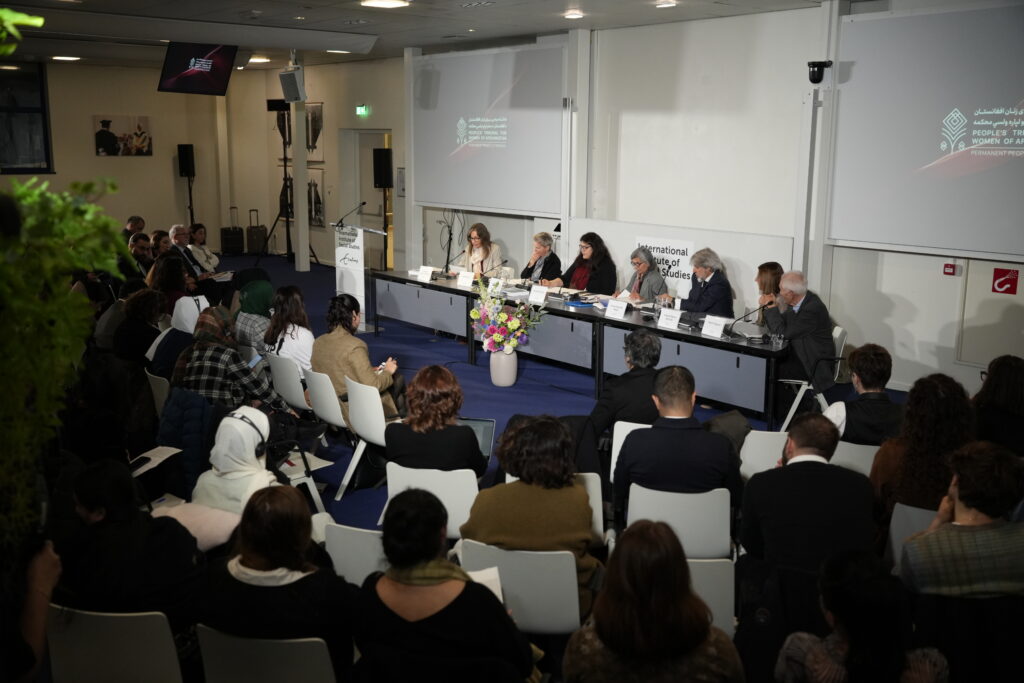
The request led to the submission of an Indictment, followed by public hearings on the situation of women in Afghanistan, which were held in Madrid at the ICAM, located at Calle de Serrano 9, from October 8 to 10, 2025. Following the procedures outlined in the PPT Statute, the Indictment was recognised as fully in line with the Tribunal’s competences and terms of reference, as documented in the series of Judgements adopted by the Tribunal over the past four decades.
A few introductory remarks could be useful for better understanding both the procedures and the historical, cultural and legal background of the PPT, which was formally established in 1979 as a follow-up to the two Russell Tribunals on Vietnam (1966–1967) and Latin American dictatorships (1974–1976). The PPT is a tool designed to promote and monitor the implementation of the Universal Declaration of the Rights of Peoples, which was proclaimed in Algiers on 4 July 1976. As the decolonisation process reached its official conclusion, it became evident that the States’ interpretation of the universality of human rights was, in practice, effectively transforming people from their collective identity as subjects with inviolable personal and collective rights into objects, and thus also victims of violations of their rights in a context of full impunity. This transformation occurred in the absence of an independent international court recognised and empowered by the States.
The PPT was established as a bottom-up tribune of visibility, legitimacy and recognised justice for those people who requested its competence with documented evidence of violations of their right to live with dignity. By documenting the type and severity of the violations through testimonies and factual/doctrinal data, people are assumed to be the real subjects of the process, with the independent Panel of Judges (not only composed of juridical competency) translating the submitted evidence into a Judgement of the causes and responsibilities. This is not only based on existing legal instruments but also provides an analysis and recommendations on what should be mandatory in order to overcome the failures, omissions and crimes of silence of the international juridical order.
The situation of women of Afghanistan, as presented in the request, was recognised by the PPT Presidency and the General Secretariat as a matter of urgent competence for the Tribunal. The targeted and brutal expression of a system of structural violations of women’s fundamental individual and collective rights, is based on the denial of their identity as inviolable subjects entitled to live with autonomy and dignity. The Indictment details all the forms of evidence on the factual, legal and cultural aspects of the violations and who bears responsibility and should be held accountable.
The significance of this session is also, and possibly specifically, of broader and more profound importance. The current situation in Afghanistan is the product of a long history, during which the country has been at the crossroads of the interests, wars, promises and betrayals of some of the major powers that have been in conflict with each other for geopolitical control of the wider region for the last four decades. This situation has already been the subject of two PPT sessions held in Stockholm in 1981 and in Paris in 1982, focused on the period of the Soviet occupation of Afghanistan.
Through their courage and resilience, the women of Afghanistan are challenging the legitimacy and credibility of an international community that is fully aware of the situation yet appears unable to address and stop a process that violates the fundamental principles of international law, which asserts the equal human dignity of all people, without exclusion or discrimination.
In strict accordance with its Statutes, the PPT aims to provide a platform that gives visibility and a voice to Afghan women, as an echo and a loudspeaker of a wider process of resistance and awareness that can stop and prevent not only the destruction of the lives of Afghan women and their right to live in freedom and dignity – but also that of women around the world, who are the guarantors of life and social reproduction, and who cannot remain the victims of gender-based colonisation, which is possibly the most deeply rooted obstacle to a human future.